Showing posts with label 1966. Show all posts

Sunday, 13 March 2016

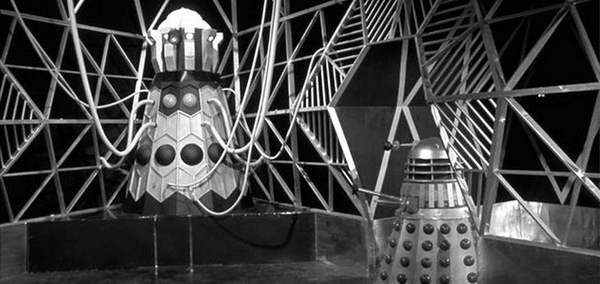
The Evil of the Daleks (TV Story) Review

Title: The Evil of the Daleks
Writer: David Whitaker
Original Broadcast Date: 20 May 1967 - 1 July 1967

"The Hybrid is not half Dalek. Nothing is half Dalek. The Daleks would never allow that!" 
These words uttered 48 years and 10 Doctors after The Evil of the Daleks seemed to be inspired by this fantastic and high-staked finale, because this is the story behind how the Doctor found that out.

The story picks off from where The Faceless Ones left us: the Doctor and Jamie, now without Ben and Polly, stuck in 1966, with the TARDIS having been stolen. Their search for the time machine leads them into the hands of Mr. Waterfield, an antique shop owner who seems to stick out like a sore thumb in the swinging '60s. The antiques that aren't so antique and the victorian-dressed Mr Waterfield prove the be the least of the Doctor's issues after he discovers a plot, devised by his worse enemies: the Daleks!

Like most stories in the fourth season, The Evil of the Daleks is missing... mostly. The second episode of this seven-parter remains the only existing episode (to our knowledge), and you can be glad of that, as it is is full of intrigue and mystery, which can't quite be captured on audio.

The story dips slightly in quality by the fifth part, but is back up again, reaching new heights by the sixth episode. What the fifth episode does lack in substantial progression, it (partly) makes up for with an intriguing investigation into what sets humans and Daleks apart. This idea's further exploration is promised, and unlike most Doctor Who episodes with interesting undertones, delivers, which leads into the clever conclusion.

Regular readers may remember my disappointment in the under-usage of Jamie in previous stories such as The Moonbase and The Highlanders, and I'm glad to say Jamie finally got time in the spotlight, given some great scenes in which he stood up to the Doctor. Just as when Barbara did the same in The Edge of Destruction, this stand lead to their friendship seeing new proximity, as the odd pair form a brilliant and entertaining duo.

The Evil of the Daleks, originally planned to be the final ever appearance of the Daleks, would have provided a lovely bow-out for everyone's favourite pepper-pot mutants, but thank god they didn't, because by the end of this glorious seven-parter I just wanted more of them!

Tuesday, 1 March 2016

The Highlanders (TV Story) Review

Title: The Highlanders
Writer: Elwyn Jones and Gerry Davis
Original Broadcast Date: 17 December 1966 - 7 January 1967

Placed right after Patrick Troughton's debut comes The Highlanders, introducing the Second Doctor's most famous and longest running companion, Jamie McCrimmon, and bringing an end to the pure historicals, being the very last one to broadcast for 15 years.

The Doctor, Ben and Polly land in Scotland, right after a battle between rebels and Red Coats, where they befriend a group of highlanders. Polly, by chance, manages to escape before British soldiers discover the rebel's hiding place and take The Doctor, Ben, Jamie, and Colin McClaren, the Laird to hang...

From that sypnosis you may have been able to figure out that this story follows the basic historical formula, with focus on imprisonment and attempts to escape, but this ceases to matter to me as it did it so well and it has its own unique charm, with a variety of unique settings and landscapes, and intriguing sub-plots.

Jamie McCrimmon in his first ever appearance is surprisingly underwhelming, and from any of the supporting cast, Kirsty, the daughter of the Laird seemed a more suitable choice for a companion from this story alone. This is mostly due to him being originally written to be a side character exclusive to this story, not planned to become a companion. This changed when the cast and crew got on so well with Frazer Hines, thus he became apart of the TARDIS team.

The Second Doctor, now settled into the role, was allowed to flex his muscles, and Troughton allowed to parade his talent, portraying The Doctor's comedy side as he deceives enemies by dressing up as an old lady, a German Doctor and a British soldier, which provides some great comedic moments. Its a shame this story is missing as I would love to see Troughton in disguise of an old crone.

The Highlanders is often overlooked by most fans, but this last hurrah for the historical genre never failed to impress me with its clever dialogue and plot, characters and hilarious comedy moments.
9/10

Friday, 26 February 2016

The Tenth Planet (TV Story) Review

Title: The Tenth Planet
Writer: Kit Pedler and Gerry Davis
Original Broadcast Date: 8 October 1966 - 29 October 1966

The Tenth Planet is the first of many things: the first appearance of the Cybermen, the first base-under-siege story and the first regeneration of the Doctor, but beyond its legendary status, the story remains standing as a clever and genuinely creepy bookend to the Hartnell era.

The Doctor, Ben and Polly land in the South Pole, 1986 where the most recent routine space flight has taken off, but strange things begin to happen. Outside the window of the spaceship the pilots see a tenth planet, that looks exactly like earth, moving towards them. And then something lands by the arctic base, something that was once human, but not anymore.

In their first ever story the Cybermen are incredibly menacing, and dare I say, scarier than the Daleks. The image of the blank faced creatures, lacking all human emotion, making its way across an icecap is particularly frightening; it is no wonder they were brought back only four stories later. My minor and only issue with them (and this story in fact) was the voiceover was sometimes out of sync with the actors, so the suspense was stunted a bit.

On the other end of the spectrum, in Hartnell's final regular appearance, he is stunning, despite his absence from the third chapter. He brings a definite gravitas to his scenes and proves his worth, making this a fantastic episode to leave in. His absence is written out fairly well, improving the regeneration with some lead up to the event, but it would have been nice to have had one of the very best Doctors at centre-stage the entirety of his final story.

His regeneration is short but sweet, and I proudly admit I shed a few tears at his final and heartbreaking line, which was such a major contrast from his frosty personality in his first few episodes, showing his growth as a character, but also seemingly a line talking directly about the show, because it didn't finish with Hartnell's departure; no; it was, it is far from being over:

"...It isn't all over. It's far from being all over... I must go now... Ah yes! Thank you. It's good! Keep warm."

9.5/10


Thank you, Mr Hartnell!


Wednesday, 24 February 2016

The Smugglers (TV Story) Review

Title: The Smugglers
Writer: Brian Hayles
Original Broadcast Date: 10 September 1966 - 1 October 1966

In Ben and Polly's first trip in the TARDIS, and Hartnell's penultimate one, we are served a fun yet slightly forgettable adventure of smugglers and pirates situated at the coast of Cornwall.

For the recent visitors, you may have noticed: this is my very first review of a missing episode and as no substantial video footage or animation are available this review is entirely based off the soundtrack, so my final rating is more of an estimate than a definite judgement as the addition of the video footage could either aid or lower the score it receives. Anyway: on with the review!

In his second-to-last story Hartnell is excellent. He achieves an wondrous charm next to his two new younger companions and the script proves the character has developed over his run, with The Doctor actively attempting to save people and going out of his way to do so, something that wouldn't have been dreamed of back in his first year.

The plot is relatively simple but by the third part gets clouded with too many unnecessary characters, something that wouldn't prove as much of a problem if I had visual aid, and without I felt a little lost and overwhelmed at times. The first two episodes, as often in the Hartnell era, are better than the final two, with the story dragging towards the end, subjecting to an unfocused wild goose chase that feels a little like a waste of time, but results in some fun.

The Smugglers is nothing special, but its not bad either. The plot is rather lackluster and is dragged on too long but the magnificence of Hartnell alongside his new companions played by Michael Craze and Anneke Wills does give this forgettable story some unforgettable moments.
7.5/10

Sunday, 21 February 2016

Season 3 - Ranking and Stats


Doctor Who - Season Three (1965/66)
11 September 1965 - 16 July 1966

After two seasons, Doctor Who faced a season of cast changes, from Vicki to Katarina, to Sara to Dodo, to Steven and finally to Ben and Polly, making up for a interesting season that feels as if it is trying to find its feet.

As so many of the stories are missing, tragically including the 13-part epic, The Dalek's Master Plan, there isn't much to rank and the average could be dramatically changed if we ever get hold of Season 3's missing episodes.


  1. The War Machines (9/10)
  2. The Gunfighters (7/10)
  3. The Ark (6.5/10)
N.A. Galaxy Four (?/10)
N.A. Mission to the Unknown (?/10)
N.A. The Myth Makers (?/10)
N.A. The Dalek's Master Plan (?/10)
N.A. The Massacre of St. Bartholomew's Eve (?/10)
N.A. The Celestial Toymaker (?/10)
N.A. The Savages (?/10)

Averaging out the very limited amount of ratings means Season 3 has an average of...
                                                                                                                          7.5/10
And a range of...                                                                                                 2.5

From this we can see the remains of Season 3 had:
1 Amazing Episode (9+/10)
1 Good Episode (7+/10)
1 Okay Episode (6+/10)

Now for the (almost pointless) graph!


Comparison

As I'm only three seasons into my marathon there isn't a lot of results to go by so this is fairly limited...

  1. Season Two - 7.94/10
  2. Season One - 7.79/10
  3. Season Three - 7.5/10
On terms of range, Seasons Three takes the top spot, with only three stories surviving, meaning it is the most consistent season so far. (Remember: the lower the range, the more consistent the series)
  1. Season Three - 2.5
  2. Season One - 5.5
  3. Season Two - 8
Join us tomorrow for stats of Dodo Chaplet, the companion with only three surviving stories, the same three as Season 3's surviving ones.


Saturday, 20 February 2016

The War Machines (TV Story) Review

Title: The War Machines
Writer: Ian Stuart Black (Idea by Kit Pedler)
Original Broadcast Date: 25 June 1966 - 16 July 1966

It might be just me but by the end of Season 3 I felt Doctor Who felt a bit distant. Steven, the companion left in the previous (missing) episode was a (needless to say a great companion but) a space traveler from the future, and Vicki the preceding companion (who was just as great) was a survivor of a spaceship crash, also from the future. Dodo, while from contemporary (or rather 1960s) London, didn't quite have to characteristics to suit the time period and felt a little out of date. Doctor Who felt a little too far from home, and The War Machines does a fantastic job of grounding the show, bringing in ties to contemporary times, something that had been missing for a large portion since Ian and Barbara's departure.

Arriving in the swinging '60s, Dodo and The Doctor go off to investigate a brand new supercomputer with the ability to think for itself. The supercomputer, WOTAN is a nicely-achieved villain, who genuinely feels quite threatening, with his hypnotic powers. The plot involved contemporary (at the time) London being invaded by WOTAN and his War Machines, the very first of Doctor Who's many earth invasion stories. Because of this, this story feels closer to New Who than any other First Doctor story.

Hartnell is great in this one, showing just how clever The Doctor can be (although watch out for him banging his head on a low ceiling in the fourth episode) and Jackie Lane finally feels at home in her role... That is until she has the worst companion departure in Doctor Who history, involving her going off because of a headache in episode two and then not appearing ever again. Instead a message passed on to The Doctor via Polly, one of the two new companions introduced in this story.

While this is a total bummer (and it didn't fit in with her character at all, previously stating she had nothing to go back to in her old life) her replacements, Ben Jackson, a cockney sailor, and Polly Wright, a spunky secretary, are introduced wonderfully and make a good team, working well with Hartnell's cheeky character.

All in all The War Machines is fantastic, but suffers from a poor exit for a hugely underrated and overlooked companion. Despite this, the introduction of Polly and Ben, two fun new companions, do somewhat make up for this massive disservice to not only the character but to Doctor Who as a whole.
9/10

Tuesday, 16 February 2016

The Ark (TV Story) Review

Title: The Ark
Writer: Paul Erickson and Lesley Scott
Original Broadcast Date: 5 March 1966 - 26 March 1966

Taking a big jump thanks to the sheer amount of missing Season 3 episodes, The Ark, the first avaliable story after The Time Meddler is an interesting one, with great concepts but poor execution.

The worst part of this story is the Monoids, which honestly looks like a lump of rubber with a mop thrown on top for the hair. They're actually quite scary looking until they start waddling about. The aforementioned ideas are rather intriguing, with a cold almost wiping out future humans due to their lack of resistance against it, but it just seems like a sidetrack for the main story to take place, over 700 years after the disease outbreak, involving the Monoids having taken over human life on the Ark.

There is a lovely idea involving a statue, but the prop just looks rather silly so the effect is ruined. There are also a few fight scenes which, with the Monoid waddling, look even worse. Dodo, in her first full story, is an interesting addition, being relatively similar to Susan and changing her accent half way through the story.

Overall, this story could have been brilliant, but with poor execution on the writing and visual front there isn't a lot to like about The Ark.
6.5/10