Showing posts with label victoria. Show all posts

Monday, 4 April 2016

Season Five: Ranking and Stats

season 5.jpg
Doctor Who: Season Five (1967/68)
2 September 1967 - 1 June 1968
The Second Doctor now comfy in the role, Patrick Troughton stars alongside Frazer Hines, as Jamie McCrimmon, and Deborah Watling, as Victoria Waterfield, in the fifth season of Doctor Who. While most fans acclaim the run highly, I found it to be the worst yet.
Here is my ranking of the seven stories:
  1. The Ice Warriors (9.5/10)
  2. The Web of Fear (8/10)
  3. Fury from the Deep (7/10)
  4. The Tomb of the Cybermen (6.5/10)
  5. The Enemy of the World (6/10)
  6. The Wheel in Space (6/10)
  7. The Abominable Snowmen (5/10)
According to my ratings season five had:
1 Amazing Episode (9+/10)
1 Great Episodes (8+/10)
1 Good Episode (7+/10)
3 Okay Episodes (6+/10)
1 Bad Episode (4+/10)

Averaging these out means season five has an average rating of…                               6.86/10And a range of                                                                                                                       4.5

Tuesday, 29 March 2016

Fury from the Deep (TV Story) Review

Title: Fury from the Deep
Writer: Victor Pemberton
Original Broadcast Date: 16 March 1968 - 20 April 1968

Coming in right towards the end of Season Five, Fury from the Deep tells the tale of a gas refinery under siege, home to a boss who shouts everything he says and creatures invading from below, and when the Doctor and his friends arrive they are not believed of the dangers until it is too late. Wait - haven't we seen this one already?

Fury from the Deep follows closely the basic Troughton story blueprint and unfortunately it isn't particularly spectacular in its execution. While it does nothing bad, it doesn't do anything good either, making this story incredibly and remarkably average.

The only real problem with this six-parter is the fact the enemy is seaweed and seafoam, which you'd think would be a lot scarier by the amount of screaming Victoria does around them. On the subject of Victoria, after a season of adventuring, we see her bow out, which was probably the only unique thing about this story. Her exit - unlike Polly, Ben, and Dodo's before her - is hinted to throughout and is really rather good, while - again, nothing spectacular - its sweet and heartwarming.

Troughton is brilliant, especially in a particular scene in the final episode involving a helicopter without a pilot, and Jamie is as good as ever. Some dialogue in the third and fourth parts gives some great insight into his character, showing his complete trust for the time lord.

Absolutely unspectacular, but good fun; Fury from the Deep is a decent base-under-siege that sits towards the top end of Season Five.
7/10

Sunday, 27 March 2016

The Web of Fear (TV Story) Review


Title: The Web of Fear
Writer: Mervyn Haisman and Henry Lincoln
Original Broadcast Date: 3 February 1968 - 9 March 1968

While last time I questioned the sanity of the man who decided to bring the Great Intelligence and their Yeti minions back for another episode; this time I'd question the sanity of the man who wouldn't want to bring them back, after this brilliant second outing, bringing out the best in the monsters.

40 years has passed since Professor Travers left Tibet, but to this day he has never spoken of what really happened. That is until his past comes back to haunt him, and three travelers he met all those years ago arrive, looking not a day older.

What makes me like The Web of Fear comes down to two major things, as what draws from it slightly are two major problems. Starting with what makes it great, the story reunites the Doctor, Jamie and Victoria with Professor Travers, now 40 years older, after his Tibetan expedition (see The Abominable Snowmen). Jack Watling portrays a brilliant yet very different man to the Travers we saw in Tibet, with age and the experience having taken his toll on him. But the great cast does not stop there: Tina Packer plays the intelligent Anne Travers, who would make a fantastic companion; Nicholas Courtney is memorable in his debut as the legendary Brigadier - although at the time, Colonel - Lethbrige-Stewart; and Derek Pollit makes a hilarious welsh army driver, who adds touch of lightness to this quite dark story.

The other thing that makes this story great is the atmosphere, which Doctor Who directing legend, Douglas Camfield captures brilliantly, utilizing the setting of the London underground to great effect. The Yetis, who I found to be pretty unspectacular in their debut, are much better in this story, and Camfield worked miracles on them, shooting them in brilliant angles to make them genuinely feel a threat.

Now onto the negatives of this story, the first being the setting. Yes!; what made the atmosphere also hindered my enjoyment somewhat, with most of the action taking place in far too similar looking corridors, simply because the story mostly took place in between tube stations. Very little progress felt like it was being made because of this, and lengthy scenes were made to feel a tad dull.

Towards the end of the six-parter the idea of a traitor was hinted at and - I shall not spoil it - a certain person was the perfect candidate for this role, and some scenes even pointed towards them. In fact, I was absolutely convinced this certain someone was in alliance with the Great Intelligence, except they weren't. No one was. There was no proper delivery on this idea at all, giving me a pang of anti-climacticy when the credits rolled up. I feel both the character and the story would have benefited from utilizing this character in the way I expected, but it opted for a plot twist, which felt more of a cop out than a game-changing u-turn.

The Web of Fear makes a much better job of the Great Intelligence, has a great setting, a wonderful cast, and an array of action sequences, making this one of the best base-under-siege stories so far.
8/10

Friday, 25 March 2016

The Enemy of the World (TV Story) Review

Title: The Enemy of the World
Writer: David Whitaker
Original Broadcast Date: 23 December 1967 - 27 January 1968

2013 was a massive year for Doctor Who, seeing the 50th anniversary of the show, but also the biggest haul of missing episodes ever: all episodes of The Enemy of the World and five out of six of The Web of Fear made its way to online and to DVD release, to be watched for the first time in almost 50 years. Since, Enemy has shot up in fans' rankings, now an under-loved classic after years of being percieved as pretty mediocre story, but was it really all it was hyped to be, or just the opinion through rose-tinted glasses after the recovery of this action-packed, Bond-like six parter?

Short answer: not quite. I often found myself questioning if I was genuinely watching Doctor Who or just some James Bond imitation on a cheap BBC budget, with, something that mostly goes without saying for most 60s Who but needs stressing in this case, terrible additional cast. In fact I found only four out of ten or so side characters to be played decently, or at least to acceptable levels for its time. The others were utterly crap, especially Milton Johns, who played the greasy, unpleasant deputy of Salamander with absolutely no hint of talent and a god awful haircut. Also watch out for Adam Verney playing Colin with the acting ability of a lamp.

For what it lacks in the ability of some additional cast, it makes up for the brilliance of the others: Mary Peach plays a brilliant woman of action as Astrid (who would make a great companion by the way), Carmen Munroe as the brilliantly developed Fariah (another great candidate for companion) and of course Patrick Troughton, who not only plays the Doctor in this story, but the evil, cunning and manipulative Salamander.

On the subject of the villain, I'd like to mention what a brilliant actor Troughton is in portraying not just two seperate characters, but with such conviction and sheer talent that they don't just seem like different characters, it seems like two entirely different actors are playing the roles. It's crazy how well he plays it! I actually had to remind myself they were the same man.

Unfortunately the way early Doctor Who episodes were filmed made this work only to an extent. Usually an episode would be film practically live with only two or three breaks in, having to wrap up filming in about 75 minutes. This meant Troughton could not be in consecutive scenes with a different costume so easily and thus rather than back and forth scenes between the villain and the time lord, there are bursts of story progression for each character for a period of time, before switching to the other one, making the various plots all feel rather disjointed and not integrated, not simultaneously building towards a crescendo like most episodes do.

This was only made worse by Frazer Hines and Deborah Watling both taking a week off for filming of episode four, and thus not appearing for a lengthy one and half episodes, meaning focus had to be shifted to the other plot strands, which felt as if they were being run into the ground just before they finally returned to the screen to my great relief. This and the fact Salamander, being Troughton, took away screen time from the Doctor, also contributed to the story not quite feeling very Doctor Who-ish.

Ending on a high note after the noticeable dip in quality in the middle, The Enemy of the World is a mixed bag: with both breathtaking and crap performances, great scenes and clunky ones, but stands out in a series of base-under-sieges with a Bond-like feel and the lack of alien presence at all.
6/10

Wednesday, 23 March 2016

The Ice Warriors (TV Story) Review

Title: The Ice Warriors
Writer: Brian Hayles
Original Broadcast Date: 11 November 1967 - 16 December 1967

In the distant future the earth has descended into another ice age and the TARDIS lands near Brittanicus Base 3300, where scientists are fighting to fend off the advancing ice glacier. Deep beneath the glacier, something sleeps: a warrior frozen within the ice.

While by the time The Ice Warriors swung around we had seen our fair share of base-under-siege episodes, I never felt we were retreading steps with this rather chilling, atmospheric six-parter, that introduced one of Doctor Who's most iconic monster, the Ice Warriors.

Something that is established right from the start is the high tension nature of this story, which doesn't get in the way of light-hearted moments (see the Doctor landing the TARDIS sideways and Jamie, Victoria and him having to climb out of the TARDIS), allowing for each regular to shine. Whether its Jamie's plead for Victoria to wear tighter clothes, Victoria faking crying to secrete her conversation with the Doctor, or the Doctor failing to pull a lid off a bottle of poison, there are many scenes throughout that remind us of the almost homely feel of the trio, something that never felt quite there with previous companions Ben and Polly.

In their debut, the Ice Warriors are brilliant, from the costume design to their voices, they stun and intrigue you whilst being rather frightening. The special effect of their gun's fire is surprisingly good, and is a neat visual effect that adds to the polish of the story.

There are some heavy undertones present in this story, tying into the conclusion with a well-handled moral, that didn't feel an afterthought at all, but a well construed, and developed idea, while not making itself too obvious with the perfect balance of subtlety.

By the end of its six parts, The Ice Warriors had offered a great base-under-siege, with high stakes and tension, a frightening monster, deep undertones, and a great use and exploration of a highly atmospheric setting, while never under or overstaying its welcome.
9.5/10

Monday, 21 March 2016

The Abominable Snowmen (TV Story) Review


Title: The Abominable Snowmen
Writer/s: Mervyn Haisman and Henry Lincolm
Original Broadcast Date: 30 September 1967 - 4 November 1967

The Doctor, Jamie and Victoria land in the Himalayas, where the previously shy and timid Yeti are reported to appear violent, attacking travelers. When the Doctor visits a Bhuddist monastery, the least he expects is to become ensnared in the plans of an extra-dimensional being.

After a mediocre outing with the Cybermen, Season 5 fails to redeem itself with this boring, drawn out six-parter that shows hints of what could have been a riveting adventure.

These glimpses mainly are in the first one and a half, and the fifth episodes, the former extremely atmospheric and compelling in its introduction, mirroring those of The Time Meddler and Marco Polo. But unlike these two masterful serials once the side characters are brought in I found myself stifling yawns during what is best described as tedious politics between the monks. These monks in question are one of the biggest problems with its story: their costumes look cheap and glued together with sequins, their characters are very one-dimensional and in places incredibly annoying, and I'm pretty sure there were no Caucasian Buddhist Abbots living in Tibet in 1935!

Beyond the first two parts, the most enjoyment I got from this story was from the chemistry between Victoria and both Jamie and the Doctor. A stark contrast to her previous story, Victoria is much more active, and is delightfully inquisitive throughout the six parts, leading scenes with great confidence and experience. Even her excessive screaming has its pluses, with it being played for the laughs early on in the story:
"If you need me for anything just yell your head off."
"Don't worry, I will!" 
By the fourth episode there is a definite feeling of claustrophobia, where the setting is severly underused: the story sticks to the first three settings it stumbles upon, making for some tedious to-and-fro. Despite this the setting makes up for some great visuals in the second and only existing part, with some gorgeous and incredibly clear location shots, some that looked less grainy than the dimly lit sets of the monastery.

The big-bad of The Abominable Snowmen, the Great Intelligence, is also the big-bad in the story's quality, never feeling like the proper villain, but rather a servant of the great (but tellytubby-like) Yeti, which is ironic considering the actual standings. While a interesting concept, the Great Intelligence doesn't actually do very much, rather than saying things in an echo-y voice and hypnotizing people (which is used as a plot-device far too often).

From this story alone I would question the sanity of the man who decided bringing them back would be a good idea, but then again they also decided to broadcast this abominable second outing in a so far poor season.
5/10

Saturday, 19 March 2016

The Tomb of the Cybermen (TV Story) Review


Title: The Tomb of the Cybermen
Writer: Gerry Davis and Kit Pedler
Original Broadcast Date: 2 September 1967 - 23 September 1967

Back yet again, the Cybermen face the Doctor, Jamie and Victoria as an archaeological dig uncovers a control centre, where deep below a chamber holds the long-lost tomb of the Cybermen - an archaeological marvel, that is until they start to wake up. Often credited as one of the best stories of Doctor Who ever, The Tomb of the Cybermen inevitably has a reputation that precedes it, but I never expected be as clumsy as it was.

My major complaint behind this four-parter is the lack of genuine threat behind the Cybermen, something that was what made previous stories such as The Moonbase and The Tenth Planet so good. This is mostly due to the fact they have very little to do throughout the story, being trapped down n the tomb for the entire length, and when they do get some action their movement seems more erratic, destroying a certain edge from their emotionless robotic factor.

Two new additions to Cybermen lore comes in the forms of the rodent-like Cybermats and the Cyberleader - I'll get to him later. The Cybermats seem like a poorly explored idea done to bring a bit more action to the story, seeing as the Cybermen are unable to get out of the tomb. This isn't the only case of this: the story constantly relies on short sequences of action that feel totally irrelevant to the plot, clutching at straws to stretch the story to fit four parts, namely the Episode 1 cliffhanger, which you later learn doesn't affect standings much at all. The aforementioned Cyberleader who again could have been quite scary isn't simply because he looks rather phallic, and doesn't add much, again feeling like another side-step just to stretch out the rather lacking main plot.

Victoria, having joined the TARDIS in the previous story, The Evil of the Daleks, doesn't do much, failing to sell me on her character, simply because all she seems to do the entire story is stay out of trouble's way and scream... a lot. She does get a bit of action when she tries to attack a Cybermen with a water bottle (again adding to her lack of suitability as a companion), but apart from that she is pretty void of any integrity or character for that matter. Despite this Troughton and Watling have some great chemistry and real potential is shown in the character by the Doctor's side.

"Ah, you scream real good, Vic!"

Missing episodes often benefit in terms of fans' opinions due to the lack of visuals, which means visual faults cannot be judged, and I feel this story would be much higher regarded if so. The direction is pretty clumsy throughout, with some erratic Cybermen attacks, and poorly thoughout camera angles and cuts. Sometimes it is not entirely clear what is going on, and I sometime had to rewind the episode to figure it out.

Despite all the problems there are glimpses of genuine script-writing genius, especially in the opening half of the first episode, setting an excellent tone, utilizing the setting of an archaeological dig that works really well in Doctor Who. Other highlights include the Doctor's interactions with his companions, with some great comedy moments (such as the Doctor and Jamie's accidental hand-holding, and Jamie's reactions to the Doctor's 'metal breakdown' pun), but also those with some great insight into the characters (such as the Doctor and Victoria's talk about the events of the previous episode and the death of her father).

"You probably can't remember your family"
"Oh yes, I can when I want to. And that's the point, really. I have to really want to, to bring them back in front of my eyes. The rest of the time they sleep in my mind, and I forget. And so will you. Oh yes, you will. You'll find there is so much more to think about. So remember, our lives are very different to anybody else's. Thats the thing. There's nobody in the universe who can do what we're doing" 

Opening Season Five in a clumsy fashion, The Tomb of the Cybermen suffers from lack of a meaty plot, leading to blatant points added in just to dial up the action, poor direction and Cybermen who feel not at all scary, but does have glimpses of brilliance, adding some redeeming factors to this highly overrated adventure.
6.5/10

Sunday, 13 March 2016

The Evil of the Daleks (TV Story) Review

Title: The Evil of the Daleks
Writer: David Whitaker
Original Broadcast Date: 20 May 1967 - 1 July 1967

"The Hybrid is not half Dalek. Nothing is half Dalek. The Daleks would never allow that!" 
These words uttered 48 years and 10 Doctors after The Evil of the Daleks seemed to be inspired by this fantastic and high-staked finale, because this is the story behind how the Doctor found that out.

The story picks off from where The Faceless Ones left us: the Doctor and Jamie, now without Ben and Polly, stuck in 1966, with the TARDIS having been stolen. Their search for the time machine leads them into the hands of Mr. Waterfield, an antique shop owner who seems to stick out like a sore thumb in the swinging '60s. The antiques that aren't so antique and the victorian-dressed Mr Waterfield prove the be the least of the Doctor's issues after he discovers a plot, devised by his worse enemies: the Daleks!

Like most stories in the fourth season, The Evil of the Daleks is missing... mostly. The second episode of this seven-parter remains the only existing episode (to our knowledge), and you can be glad of that, as it is is full of intrigue and mystery, which can't quite be captured on audio.

The story dips slightly in quality by the fifth part, but is back up again, reaching new heights by the sixth episode. What the fifth episode does lack in substantial progression, it (partly) makes up for with an intriguing investigation into what sets humans and Daleks apart. This idea's further exploration is promised, and unlike most Doctor Who episodes with interesting undertones, delivers, which leads into the clever conclusion.

Regular readers may remember my disappointment in the under-usage of Jamie in previous stories such as The Moonbase and The Highlanders, and I'm glad to say Jamie finally got time in the spotlight, given some great scenes in which he stood up to the Doctor. Just as when Barbara did the same in The Edge of Destruction, this stand lead to their friendship seeing new proximity, as the odd pair form a brilliant and entertaining duo.

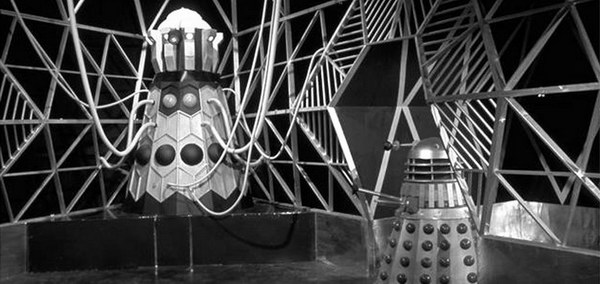
The Evil of the Daleks, originally planned to be the final ever appearance of the Daleks, would have provided a lovely bow-out for everyone's favourite pepper-pot mutants, but thank god they didn't, because by the end of this glorious seven-parter I just wanted more of them!